



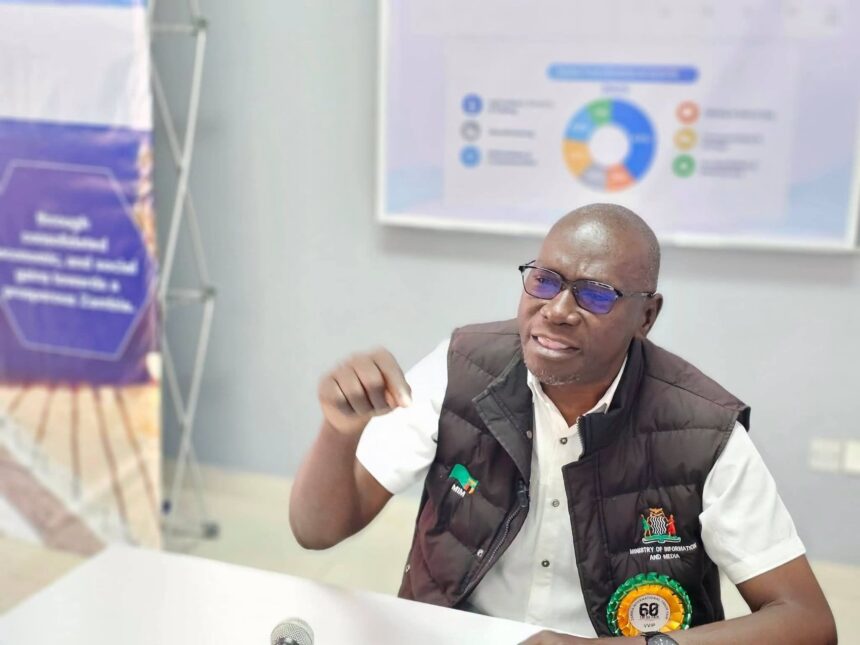
Information and Media Permanent Secretary Thabo Kawana used his visit to the Ministry of Finance and National Planning stand at the Zambia International Trade Fair in Ndola, Copperbelt Province, to address several issues that have dominated public debate ahead of Zambia’s August 13 general elections. His statement focused on public debt, infrastructure spending, free education and what he described as the need to correct misinformation circulating about the Government’s performance. Kawana rejected claims that the current administration had borrowed more money in five years than the previous administration did in ten years, arguing that such assertions were inaccurate and intended to mislead voters. He emphasized that the Government remained committed to providing factual information so that citizens could make informed decisions during the election period. His remarks formed part of a broader effort to explain the administration’s position on key national issues that continue to attract public attention.
Addressing Zambia’s public debt, Kawana presented figures that he said reflected the country’s financial position when the current administration came into office. According to the Permanent Secretary, Zambia’s public debt stood at approximately US$24.6 billion in 2021 when the Government assumed office. He explained that by the 2025/2026 period, the debt had increased to about US$28.9 billion, representing a rise of US$4.3 billion over five years. Kawana argued that these figures directly contradict allegations that the current administration had accumulated excessive debt in a relatively short period. He maintained that the available data demonstrates a much smaller increase than what has been claimed by critics.
Kawana also compared the borrowing records of the current and previous administrations to provide additional context. He stated that the previous administration borrowed more than US$20 billion during its time in office, with approximately US$14.5 billion contracted between 2015 and 2021 alone. Based on these figures, he argued that the previous Government accumulated significantly more debt than the current administration over a shorter period. He said this comparison should help the public better understand the actual borrowing trends rather than relying on political statements or unverified claims. According to Kawana, discussions about public debt should be guided by documented financial records rather than misinformation.
The Permanent Secretary further questioned whether the infrastructure projects undertaken under the previous administration reflected the amount of money that had been borrowed. He acknowledged that bridges, hospitals and airports were constructed during that period, but argued that the value of those developments did not correspond with the scale of the borrowing. Kawana suggested that some projects were implemented at inflated costs, raising concerns about value for money. He said a responsible Government should always be able to account for borrowed funds by demonstrating corresponding national assets that justify the expenditure. His comments highlighted the importance of transparency and accountability in the management of public resources.
Education policy also featured prominently in Kawana’s remarks during the tour of the trade fair. He dismissed claims that the previous administration introduced free education, describing such assertions as “laughable.” According to him, it was the current administration that reintroduced free education as part of its commitment to improving access to learning across Zambia. He said this policy has enabled more than 2.5 million learners who had previously been unable to attend school because of financial challenges to return to the classroom. Kawana argued that the impact of the programme demonstrates the Government’s focus on expanding educational opportunities for children and young people throughout the country.
Kawana also addressed campaign promises relating to infrastructure development, specifically referring to the proposed construction of an airport in Nakonde. He criticized suggestions that such a project represented a future campaign pledge designed to attract voters. Instead, he stated that construction of the airport is already underway, making claims about future delivery misleading in his view. He said it was important for the public to distinguish between projects that are already being implemented and promises that suggest work has not yet started. His comments were intended to reassure citizens that some development initiatives highlighted during the election period are already progressing.
Throughout his statement, Kawana stressed that his remarks should not be interpreted as part of a political campaign. He explained that his intention was to correct what he described as false information being circulated regarding the Government’s performance and policy achievements. According to the Permanent Secretary, providing accurate information is necessary to ensure that public debate is based on verified facts rather than misleading narratives. He said Government institutions have a responsibility to respond whenever inaccurate claims have the potential to confuse the public or distort national issues. This approach, he added, is particularly important during an election period when information can significantly influence public opinion.
The Government has indicated that it will continue responding to statements it considers misleading as Zambia moves closer to the August 13 general elections. Kawana said citizens deserve access to factual information about public debt, national development projects, education policies and other matters affecting the country’s future. He maintained that open communication and clarification of Government records are essential for strengthening public understanding of national affairs. As political debate continues, issues such as borrowing, infrastructure development and access to education are expected to remain central topics in Zambia’s election campaign. The statement delivered at the Zambia International Trade Fair reflects the Government’s intention to defend its record while challenging claims it believes do not accurately represent the country’s recent history.