







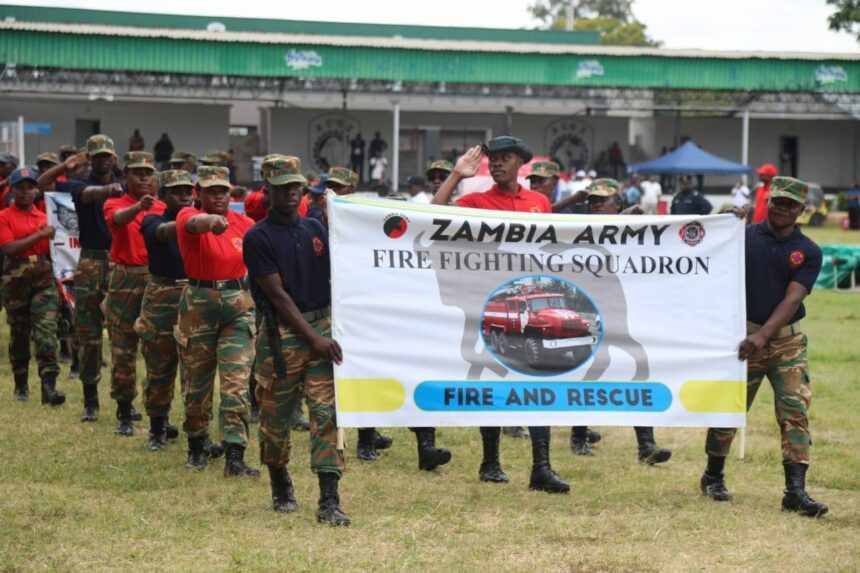
The Government of Zambia has reaffirmed its commitment to strengthening fire and emergency services across the country, recognizing the vital role firefighters play in protecting lives, property and national infrastructure. This renewed focus comes at a time when urban growth, industrial expansion and climate-related risks continue to increase the demand for efficient emergency response systems. Speaking during the commemoration of International Firefighters’ Day held in Lusaka on Monday, Minister of Local Government and Rural Development Honourable Gift Sialubalo outlined government’s ongoing efforts to modernize and expand fire services. He emphasized that investing in emergency response is not optional but necessary for national safety and resilience. The event also served as a platform to recognize the bravery and dedication of firefighters who continue to serve under demanding and often dangerous conditions.
Honourable Gift Sialubalo highlighted that firefighters consistently demonstrate exceptional courage, often risking their lives to protect communities from devastating incidents. He described them as among the country’s most committed public servants, noting that their work requires both physical endurance and mental resilience. Emergency responders operate in unpredictable environments where quick decision-making can mean the difference between life and death. Their professionalism and discipline ensure that incidents are handled efficiently, even under extreme pressure. The Minister commended their selfless service, stressing that their contribution remains essential to maintaining public safety and stability across Zambia.
Government has already taken concrete steps to improve fire response systems and infrastructure in key areas. The Ministry has funded the construction of new fire stations in Lusaka and Kasama to address growing demand in urban and peri-urban communities. Additional facilities have been developed in Mpika, Siavonga and Chirundu with support from local authorities. These investments aim to reduce response times and improve coverage in areas that previously faced limited access to emergency services. Improved infrastructure allows firefighters to respond faster and operate more effectively during emergencies. This expansion reflects a broader strategy to ensure that fire services keep pace with population growth and economic development.
The Minister also revealed that a new Fire Bill is at an advanced stage and is expected to significantly strengthen fire prevention and response once enacted. The proposed legislation aims to establish a modern and coordinated national emergency response framework that aligns with current safety standards. It will introduce clearer guidelines for fire safety compliance and improve coordination among different emergency service providers. A stronger legal framework will also support better resource allocation and accountability within the sector. This development marks a shift toward a more structured and proactive approach to managing fire risks across the country.
In addition to infrastructure and legislation, government is prioritizing capacity building to improve the overall effectiveness of fire and emergency services. Training programmes are being expanded to equip firefighters with updated skills and knowledge required to handle complex emergencies. Investments are also being made in mobility, communication systems and disaster preparedness tools to ensure rapid and coordinated responses. Enhanced communication systems allow teams to share critical information in real time, improving operational efficiency during incidents. These improvements are expected to strengthen the ability of emergency services to respond to fires, accidents and other disasters with greater precision and speed.
Honourable Sialubalo stressed that fire safety is not solely the responsibility of government but requires active participation from communities, businesses and institutions. He urged stakeholders to comply with safety regulations and invest in preventive measures such as early warning systems and functional fire hydrants. Preventive action reduces the likelihood of large-scale incidents and minimizes damage when emergencies occur. Community awareness and preparedness play a crucial role in supporting firefighters and improving overall response outcomes. By working together, citizens and authorities can create safer environments and reduce the risks associated with fire hazards.
The Minister further called on citizens to support fire services by adopting proactive fire prevention practices in their daily lives. Simple measures such as regular safety checks, proper storage of flammable materials and adherence to building regulations can significantly reduce fire risks. Community vigilance enhances the effectiveness of firefighting operations by ensuring that incidents are reported quickly and accurately. Public cooperation also allows emergency responders to focus on critical tasks without unnecessary delays. Strengthening this partnership between communities and fire services is essential for building a culture of safety and responsibility.
Zambia’s renewed commitment to strengthening fire and emergency services reflects a clear understanding of the challenges posed by modern development and environmental risks. By investing in infrastructure, advancing legislation and improving capacity, government is laying the foundation for a more responsive and resilient emergency system. The recognition of firefighters’ dedication reinforces the importance of supporting those who serve on the front lines of public safety. Continued collaboration between government, communities and emergency responders will be key to sustaining these improvements. This approach ensures that Zambia is better prepared to protect lives and property while building a safer future for all citizens.