




The Government of Zambia and the United States of America have signed a Memorandum of Understanding (MoU) and a Data Sharing Agreement to support the implementation of a five-year health sector cooperation programme valued at more than $1.5 billion in American assistance. The agreements are intended to strengthen Zambia’s healthcare system, improve access to essential medicines, support the recruitment of health workers and enhance disease surveillance across the country. Under the arrangement, the United States will provide more than $1.5 billion to support Zambia’s priority health programmes over five years, while the Zambian government has committed to increasing domestic health expenditure by $975 million. The signing marks an important development in bilateral relations between the two countries, with both governments highlighting shared responsibility, stronger health financing and improved health outcomes as key priorities. The agreement also comes as Zambia faces economic pressures and climate-related challenges that continue to place demands on public resources.
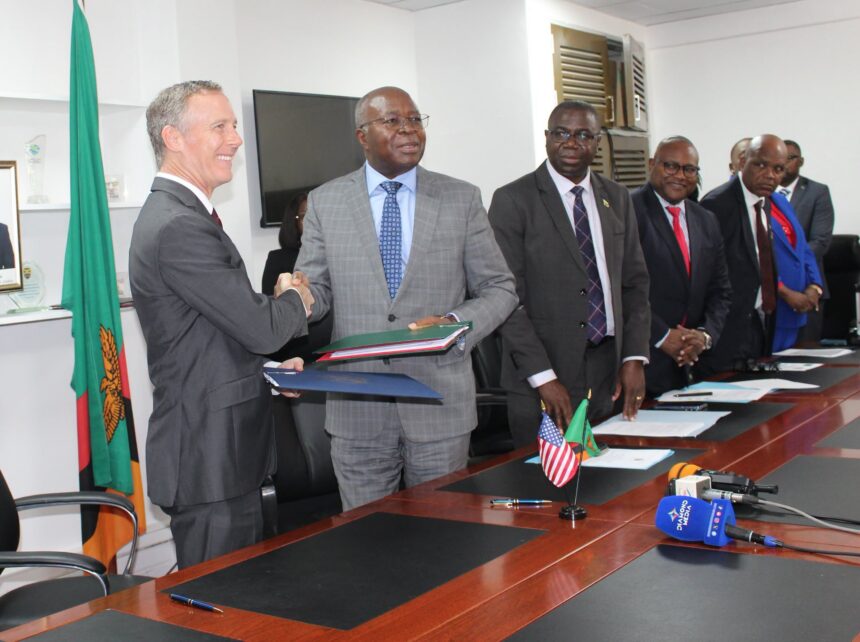
The agreements were signed in Lusaka by senior representatives of the Zambian and American governments. Minister of Finance and National Planning, Hon. Dr. Situmbeko Musokotwane, M.P., signed the Memorandum of Understanding on behalf of Zambia, while Minister of Health, Hon. Professor Roma Chilengi, M.P., signed the Data Sharing Agreement. Representing the United States government, Chargé d’Affaires at the United States Embassy in Lusaka, Mr. Mich Coker, signed the agreements on behalf of his country. The documents are intended to provide a framework for implementing the five-year United States-Zambia Health Sector Cooperation Agreement. Their signing establishes a formal basis for cooperation on funding, health programme implementation, domestic financing commitments and the sharing of programme-related data.
Speaking during the signing ceremony, Minister of Foreign Affairs and International Cooperation, Hon. Mulambo Haimbe, S.C., M.P., expressed appreciation to the United States government and the American people for their longstanding partnership with Zambia. He described the agreement as a renewal and redefinition of the relationship between the two countries. According to the minister, strengthened cooperation would continue to shape and positively transform the lives of Zambians through support for priority health programmes and related development objectives. His remarks highlighted the importance of maintaining international partnerships that respond to Zambia’s national priorities. The agreement also reflects an effort by both governments to establish a clearer framework for cooperation while addressing issues that had previously raised concerns.
Hon. Haimbe further explained that the health sector agreement was no longer linked to the signing of a Critical Minerals Framework. The proposed connection between the two matters had initially raised reservations on the part of the Zambian government. He stated that the issues had been successfully separated following discussions between the two countries. This distinction is significant because it establishes the health cooperation arrangement as a separate matter from negotiations concerning critical minerals. The separation also demonstrates the role of consultation in resolving differences and allowing both governments to proceed with an agreement focused on healthcare priorities.
The five-year programme places substantial emphasis on improving Zambia’s ability to finance and deliver essential health services. The United States has committed more than $1.5 billion in support of the country’s priority health programmes, while Zambia has pledged to increase its domestic health expenditure by $975 million. These commitments bring attention to the need for both external support and national investment in strengthening healthcare services. International assistance can help address immediate funding gaps, while increased domestic spending can support continuity and reduce long-term dependence on external financing. The effectiveness of the arrangement will depend on how the funds are allocated, how programmes are implemented and how both governments monitor progress towards their agreed objectives.
Minister of Health Professor Roma Chilengi said the agreement would serve as a catalyst for Zambia’s journey towards greater self-sustainability and improved domestic resource mobilisation. He explained that the additional support would help the government recruit more health workers, strengthen the supply of medicines and improve the country’s capacity for disease surveillance. These areas are essential to the delivery of reliable healthcare, particularly in communities where shortages of personnel, medicines or diagnostic resources can affect access to treatment. Recruiting additional health workers could help strengthen staffing capacity, while more reliable medicine supplies could support patients who depend on public health facilities. Enhanced disease surveillance could also improve the country’s ability to identify, monitor and respond to public health threats.
The commitment to strengthen Zambia’s health workforce is particularly relevant to the delivery of healthcare across the country. Health workers provide essential services ranging from routine consultations and maternal care to the treatment of infectious diseases and the management of long-term conditions. Increasing staffing levels can help health facilities respond to patient needs, although recruitment must also be supported by adequate training, equipment, medicines and working conditions. The proposed cooperation programme is expected to provide resources that can contribute to these broader health system needs. Its practical impact will depend on how effectively the government directs funding towards priority areas and ensures that the benefits reach health facilities and communities.
Reliable access to medicines is another key priority under the agreement. Public health facilities need consistent supplies of essential medicines and medical products to provide effective treatment and reduce interruptions in care. Supply shortages can place additional pressure on patients and healthcare workers, particularly when people must travel long distances or pay for medicines elsewhere. Strengthening medicine supply systems can help improve the availability of treatment and support more consistent service delivery. The programme’s intended contribution in this area will therefore be important to patients who rely on government health facilities for affordable healthcare.
Disease surveillance also forms part of the health sector priorities identified by the government. Effective surveillance enables health authorities to collect and assess information about diseases, detect unusual patterns and respond to potential outbreaks. This work depends on reliable reporting systems, trained personnel, suitable laboratory capacity and timely communication between health facilities and public health authorities. Improving these systems can help Zambia respond more effectively to infectious disease threats and other public health emergencies. The agreement’s support for surveillance capacity is intended to strengthen the systems that help protect communities and guide public health decisions.
Professor Chilengi also addressed the issue of data sharing under the agreement. He stated that the information Zambia would be required to share with the United States during the agreement period would be limited to data directly related to programme operations. This clarification was important because the Data Sharing Agreement forms a formal part of the broader health cooperation arrangement. The practical implementation of this provision will depend on the specific data requirements and the procedures established by the two governments. Clear rules on data access, use, protection and accountability remain important considerations whenever health-related information is shared between countries.
Minister of Finance and National Planning Dr. Situmbeko Musokotwane said the agreement had been signed at a time when Zambia was facing financial pressures arising from global economic factors and the anticipated severe drought in the following year. Such pressures can complicate government budget planning by increasing competing demands for limited public resources. Support for priority health programmes could help the government manage some of these demands while directing domestic funding towards other essential sectors. Dr. Musokotwane explained that the agreement would provide much-needed relief and enable the government to channel additional resources into other areas of the economy. He linked this opportunity to the government’s Grow Zambia Agenda, which guides its broader development priorities.
The additional health financing could give Zambia greater room to plan public spending while maintaining essential healthcare services. However, the government’s commitment to increase domestic health expenditure by $975 million also represents a substantial responsibility over the five-year period. Meeting that commitment will require careful budgeting, effective public financial management and decisions about how resources are distributed across national priorities. Sustainable health financing depends not only on the amount of money available but also on how efficiently it is used and whether spending improves service delivery. The agreement therefore places importance on both external assistance and Zambia’s capacity to strengthen its own contribution to healthcare.
For the United States, the agreement represents a shift towards a partnership model based on shared responsibility and stronger local ownership. During the signing ceremony, Chargé d’Affaires Mich Coker described the arrangement as a transformative partnership that moves beyond the traditional donor-recipient model. He emphasised Zambian leadership, Zambian ownership and shared accountability as central principles of the cooperation. He also stated that the agreement focuses on improving health outcomes, strengthening health financing and enhancing systems within Zambia’s health sector. These priorities place greater emphasis on building national capacity alongside providing financial support.
The emphasis on Zambian leadership means that the country’s own institutions and development priorities remain central to the implementation of the programme. Strong national ownership can help ensure that health investments respond to local needs and fit within existing public health strategies. Shared accountability also requires both governments to understand their responsibilities and assess whether the agreed commitments are being met. Regular monitoring, transparent financial management and clear reporting arrangements can help identify challenges and guide adjustments during implementation. These measures will be important in determining whether the agreement produces lasting improvements in healthcare access and quality.
The stakeholders also confirmed that outstanding issues initially contained in the Memorandum of Understanding had been resolved through mutual consultations between the two governments. This development cleared the way for the signing of the agreements and demonstrated the importance of dialogue in reaching a mutually acceptable arrangement. Resolving outstanding concerns is an important step, although implementation will require continued cooperation as the programme progresses. Both sides will need to coordinate their activities, manage the agreed resources and address any challenges that arise during the five-year period. The success of the partnership will ultimately depend on whether the commitments translate into measurable improvements for patients and health facilities.
The Zambia-United States Health Sector Cooperation Agreement represents a significant commitment to strengthening healthcare delivery, improving health financing and supporting the development of Zambia’s public health system. With more than $1.5 billion in planned United States assistance and a $975 million commitment to increased domestic health expenditure, the programme combines external support with greater national investment. Its priorities include recruiting health workers, improving medicine availability, strengthening disease surveillance and building more sustainable health systems. The separation of the health agreement from the Critical Minerals Framework also clarifies the scope of the cooperation, while the Data Sharing Agreement establishes a framework for programme-related information sharing. As implementation moves forward, transparent management, effective coordination and a sustained focus on public health needs will be essential to ensuring that the agreement delivers meaningful and lasting benefits for the people of Zambia.