






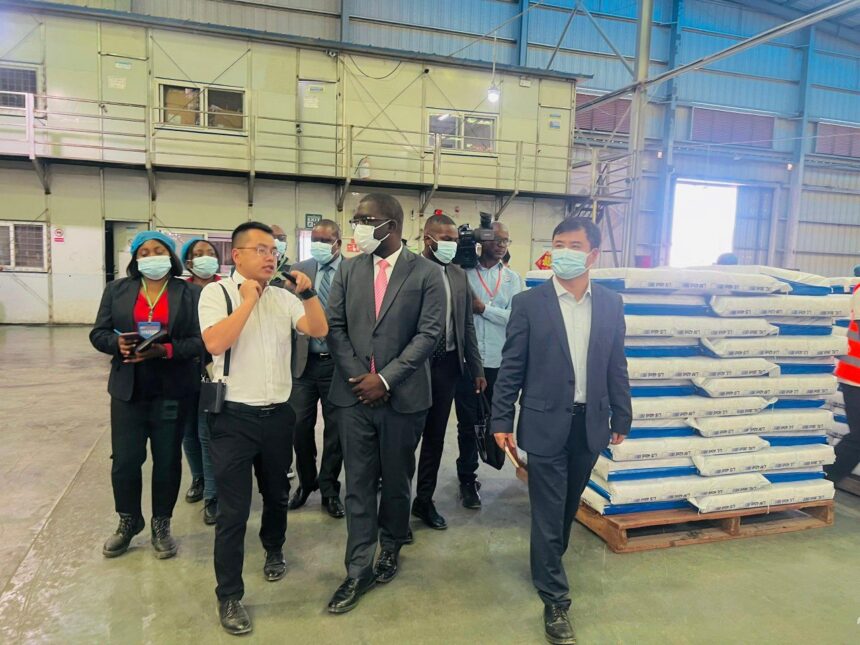
Minister of Commerce, Trade and Industry Hon. Chipoka Mulenga, MP, has restated Government’s strong commitment to industrialization and export-led growth as key pillars for Zambia’s economic transformation. The Minister made the remarks during an official tour of SoftCare Industrial Zambia Limited, a major manufacturing investment operating in the Lusaka South Multi-Facility Economic Zone. The visit highlighted the Government’s focus on strengthening local production capacity, attracting foreign direct investment, and expanding export markets for Zambian-made goods. It also underscored the role of Special Economic Zones in driving industrial development and job creation across the country. The engagement reflected a broader national agenda aimed at building a resilient, production-driven economy.
SoftCare Industrial Zambia Limited, a subsidiary of Sunda International, operates within the Lusaka South Multi-Facility Economic Zone, one of Zambia’s strategic industrial hubs designed to attract investment and promote export-oriented manufacturing. The company manufactures sanitary pads, baby wipes, and diapers, serving both domestic and regional markets. During the tour, management disclosed that it has invested more than USD20 million into its operations, establishing a modern production facility that has created over 500 direct jobs. The investment has also stimulated indirect employment opportunities for local transporters, suppliers, and small-scale service providers. The company further indicated the need for additional land to expand its production capacity and meet rising demand across African markets.
Minister Mulenga responded by stating that the Ministry will engage the management of the Lusaka South Multi-Facility Economic Zone and the Industrial Development Corporation to assess the possibility of reallocating idle land that has remained undeveloped for over a decade. He emphasized that productive land use remains a national priority, particularly where it can support industrial expansion, value addition, and employment creation. The Minister noted that underutilized industrial land must be activated to support investors who are ready to scale operations and contribute to national development goals. His remarks signaled a firm policy direction toward maximizing existing infrastructure within designated economic zones. He also highlighted the importance of ensuring that investment environments remain efficient and responsive to business needs.
During the briefing, SoftCare Industrial Zambia Limited revealed that approximately 40 percent of its total production is exported while 60 percent is consumed locally. The company currently exports to more than five African countries, including the Democratic Republic of Congo, Malawi, Zimbabwe, and South Africa. This export performance was recognized by the Minister as a positive contribution to Zambia’s foreign exchange earnings and Kwacha stability. He stressed that increasing Non-Traditional Exports is essential for strengthening macroeconomic stability and improving the country’s trade balance. The Minister further emphasized that industrial output must translate into competitive exports that can sustain long-term economic resilience.
Hon. Mulenga also addressed the importance of workforce productivity in supporting national export ambitions. He encouraged employees to maintain high production standards and to fully commit to operational excellence within the facility. He stated, “We cannot export if every employee and staff is not putting in more than is expected,” while commending workers for their dedication and discipline. The Minister further urged staff to treat the facility as their own and to take pride in their contribution to national development. He also called on management to uphold labour regulations and maintain fair, motivating working conditions that support employee retention and productivity. He added that job satisfaction is influenced not only by wages but also by workplace culture and stability.
SoftCare Industrial Zambia showcased its advanced production systems, describing the facility as one of the most technologically sophisticated hygiene manufacturing hubs in the region. The company highlighted its investment in specialized technical training programs aimed at building local skills and improving operational efficiency. It also noted that it contributes over K100 million annually in taxes, reinforcing its role in supporting public revenue and national development priorities. Managing Director Paul Wang explained that local production helps reduce reliance on imports while preserving foreign exchange reserves. He further stated that the company’s distribution network supports thousands of small retailers and distributors across Zambia, strengthening local commerce and supply chains.
Mr. Wang reaffirmed SoftCare’s mission to expand access to high-quality hygiene products under the brand promise “More Care, More Love.” He welcomed the Ministry’s proactive approach to trade facilitation and called for continued collaboration to protect local manufacturers from unfair competition in the market. He expressed confidence in Zambia’s investment climate and emphasized the company’s commitment to ensuring that the “Made in Zambia” brand achieves international recognition for quality and reliability. The company also reiterated its broader role in strengthening industrial self-sufficiency through consistent local production and market expansion across the region.
Beyond manufacturing, SoftCare Industrial Zambia Limited highlighted its commitment to social impact through Corporate Social Responsibility initiatives focused on maternal and child health. The company stated that access to hygiene products plays a direct role in improving public health outcomes, particularly for women and children. Mr. Wang noted that a healthy population is essential for sustainable economic growth, emphasizing the link between industrial development and community well-being. The company’s CSR programs are designed to complement its commercial operations while contributing to national health and social development priorities. This dual focus reinforces its position as both a business enterprise and a development partner.
The visit to SoftCare Industrial Zambia Limited reinforced Government’s broader industrialization agenda and its commitment to supporting export-driven manufacturing. It highlighted the importance of strategic partnerships between the public sector and private investors in unlocking economic growth and job creation. The engagement also demonstrated how Special Economic Zones can serve as catalysts for large-scale industrial expansion when effectively managed and supported. With continued investment, policy coordination, and workforce development, Zambia aims to strengthen its manufacturing base and expand its presence in regional and global markets.