





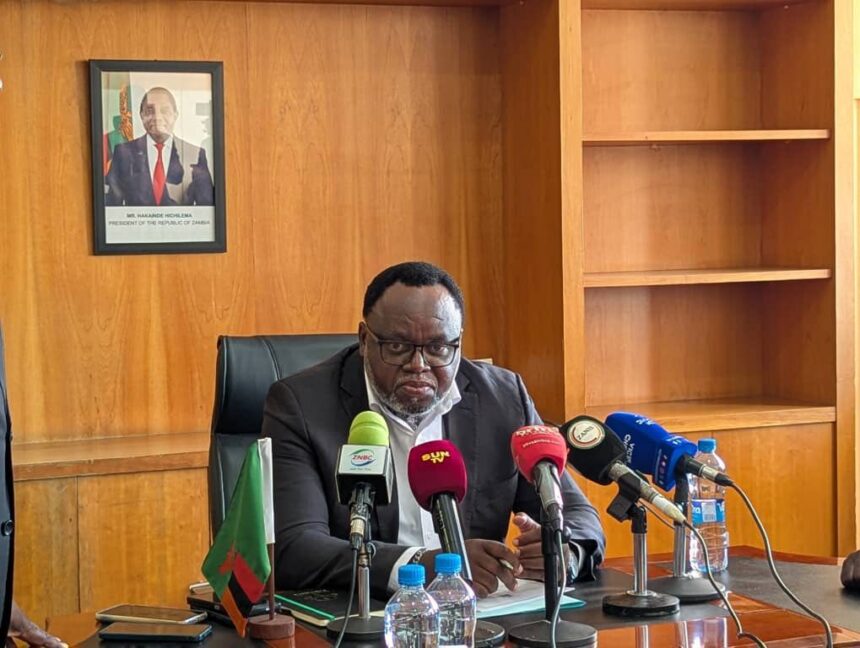
This morning, Zambia’s Minister of Mines and Mineral Development Hon. Paul Kabuswe MP held a press briefing to present the country’s mining performance for the first quarter of 2026. The update highlighted a sector that continues to expand in several key areas while also facing pressure in others, especially copper output. The Minister pointed to increased investor confidence, mine recapitalisation and ongoing reforms as key drivers of overall stability. Government policy continues to focus on strengthening mining as a central pillar of economic growth. The briefing also stressed that diversification is now a major priority to reduce overdependence on copper.
The Minister reported that total copper production declined by 4.27 percent, moving from 218,308.2 metric tonnes in Q1 2025 to 208,992.66 metric tonnes in Q1 2026. Despite this decline, large scale mining operations showed resilience with a 1.8 percent increase in copper output, driven by improved efficiency and operational stability. Individual mine performance showed mixed results across the sector. Kansanshi Mine recorded a 4.25 percent drop due to lower ore grades, while Lumwana Mine achieved a strong 19.2 percent increase due to improved capacity and better mining efficiency. Mopani Mine posted a 4.39 percent rise, and Konkola Mine delivered a significant 22.02 percent increase in copper production. NFCA experienced a 10.51 percent decline linked to phased recovery from care and maintenance operations. Small scale copper production fell sharply by 56.04 percent, largely due to poor compliance in production reporting requirements.
Beyond copper, the report showed strong growth in other minerals, supporting the government’s diversification agenda. Gold production rose by 13.2 percent, while cobalt increased by 9.15 percent. Nickel recorded a major surge of 142.75 percent, reflecting rising industrial activity and renewed interest in the mineral. Emerald production also grew significantly by 241.41 percent, reinforcing the strength of Zambia’s gemstone sector. Coal output increased by 36.32 percent and cement production rose by 8.31 percent, indicating broader industrial expansion linked to mining activity. Ferro-silicon manganese production declined by 4.09 percent due to ongoing electricity supply challenges, which continue to affect parts of the mining value chain.
The government also addressed regulatory and institutional developments affecting the sector. No mining licenses were issued in the first quarter of 2026 because the Minerals Regulation Commission Board had not yet been constituted during that period. The Minister confirmed that this gap has now been addressed with the appointment of the inaugural Board of the Minerals Regulation Commission on 6 May 2026. He assured stakeholders that all pending mining applications will now be processed in a transparent and efficient manner. The Local Content Access System was also operationalised during the quarter to strengthen monitoring of local participation in mining supply chains. In addition, the countrywide high resolution aerial geophysical survey reached 73 percent coverage by 11 May 2026, with expectations that it may be completed ahead of schedule, possibly by August 2026.
Artisanal and small scale mining also received attention in the briefing, with the government highlighting efforts to formalise and support the subsector. The Zambia Gold Company purchased 3.65 kilograms of gold from artisanal miners, marking an 84.36 percent increase compared to the same period in 2025. Government support included an injection of more than ZMW 8.5 million into the artisanal mining subsector to improve productivity and safety. A total of 237 artisanal mining cooperatives in Southern Province received training in safe mining practices and environmental management. The Minister reaffirmed government commitment to tackling illegal mining activities while improving compliance and oversight across the sector. The broader goal remains ensuring that mining growth translates into jobs, infrastructure development, stronger public revenue and improved living standards for citizens across the country.