






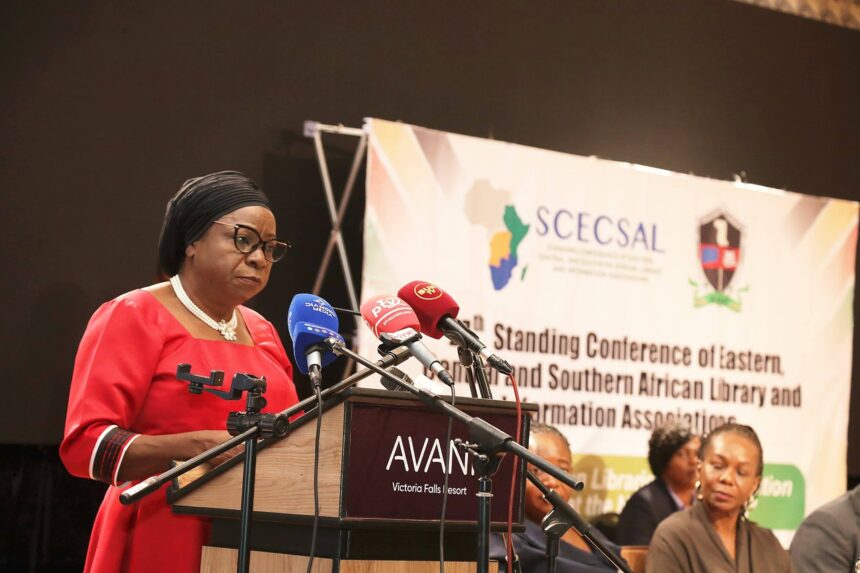
Zambia has marked a significant milestone in the regional library and information sector by officially opening the 27th Standing Conference of Eastern, Central and Southern African Library and Information Associations (SCECSAL) in Livingstone. The opening ceremony was led by Dr W.K Mutale-Nalumango, Vice President of the Republic of Zambia. The high-level gathering is taking place at the Avani Victoria Falls Resort, a venue that has brought together delegates from across Africa and beyond. The conference provides a platform for professionals in library and information services to engage on pressing issues affecting the sector. It also reinforces Zambia’s role as a regional hub for knowledge exchange and intellectual development.
In her opening remarks, the Vice President emphasized the importance of adapting to rapid technological change while maintaining the integrity, credibility, and security of information systems. She highlighted that libraries and information institutions are no longer limited to physical collections but are now deeply integrated into digital ecosystems. This shift requires professionals to adopt new tools, systems and approaches that respond to the evolving needs of users. At the same time, she stressed that trust in information remains a key pillar that must not be compromised. The balance between innovation and reliability was presented as a central challenge for institutions in the digital age.
The conference has attracted delegates from a wide range of countries across the African continent as well as international participants. This broad representation reflects the growing importance of collaboration in addressing shared challenges in the library and information sector. Participants include librarians, information scientists, researchers, policymakers and technology experts. Their presence allows for cross-border dialogue on how institutions can strengthen access to knowledge and improve service delivery. The diversity of expertise also supports more practical and inclusive discussions during the sessions.
The central theme of the conference, “African Libraries and Information Services at the New Crossroads,” reflects the changing landscape of information management. Libraries are increasingly expected to support digital learning, research innovation and public access to reliable data. This shift has been accelerated by advances in technology and the growing demand for digital services. The theme encourages participants to reflect on how institutions can remain relevant while embracing transformation. It also highlights the need for strategic planning in response to emerging global trends in information access and management.
Discussions at the conference are focused on several key areas, including digital transformation, knowledge dissemination and the role of libraries in national development. Information institutions are being recognized as critical players in supporting education systems, research communities and policy development. The integration of digital platforms has expanded the reach of libraries beyond traditional physical spaces. However, it has also introduced challenges related to cybersecurity, data protection and information authenticity. These issues are central to the conversations taking place during the conference sessions.
A strong emphasis has also been placed on the role of libraries in supporting national development goals. By providing access to reliable and organized information, libraries contribute to education, innovation and informed decision-making. The conference discussions highlight how improved information systems can support economic growth and social development. Participants are examining how libraries can better align their services with national priorities and community needs. This includes expanding digital access, improving infrastructure and investing in capacity building for information professionals.
The opening of SCECSAL in Livingstone also reinforces Zambia’s commitment to regional cooperation in the knowledge sector. Hosting the conference provides an opportunity for the country to showcase its hospitality and engage with leading experts in library and information sciences. It also allows local professionals to interact with international counterparts and share best practices. The exchange of ideas is expected to strengthen institutional capacity across participating countries. Such engagements contribute to building a more connected and informed African information network.
The discussions taking place at the Avani Victoria Falls Resort are expected to produce insights that will shape the future of libraries and information services in the region. The focus on digital transformation and information security reflects the urgent needs of modern institutions. As technology continues to evolve, libraries are being challenged to redefine their roles and services. The outcomes of the conference are likely to influence policy directions, professional standards and collaboration frameworks across member associations. The event underscores the importance of continuous learning and adaptation in the information sector.