







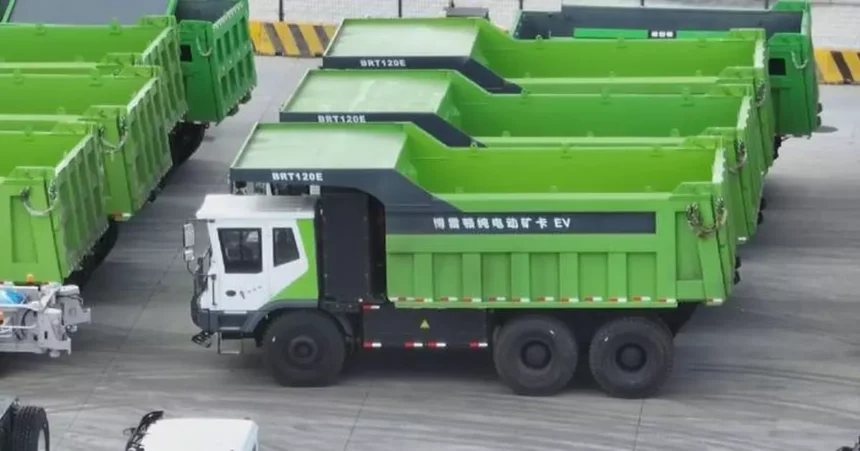
In a groundbreaking move for Africa’s extractive industries, China has dispatched a fleet of 31 pure electric mining trucks to Zambia, marking one of the continent’s first large-scale deployments of green mining technology. The trucks, manufactured by Chinese high-tech firm Breton Technology, set sail on Sunday and are bound for a major copper mining project in Zambia, signaling a significant step toward sustainable mining practices in Africa.
This initiative is a collaboration between Breton Technology and the African branch of China’s state-owned 15th Metallurgical Construction Group, which is responsible for overseeing construction projects in the region. Li Wenjie, chairman of the Group’s construction trade arm in Africa, emphasized the importance of the deployment, stating, “This overseas cooperation is the first of its kind and will help further upgrade local mining equipment.”
Breton Technology, a leader in green construction machinery, is also providing a cutting-edge zero-carbon mining robot system as part of the project. The system combines autonomous driving with clean energy technologies, reflecting a vision of future mining operations that are both automated and environmentally friendly. Teng Fei, head of strategy and overseas business at Breton, confidently stated, “We believe that in the near future, unmanned mining fleets will be seen operating in Africa.”
The electric trucks are expected to arrive at the port of Durban, South Africa, after a 20- to 25-day sea voyage. From there, they will be transported overland to their final destination in Zambia, ready to support the copper mining operations.
This technological advancement aligns with China’s broader commitment to invest $5 billion into Zambia’s mining sector by 2031 under the Belt and Road Initiative. The influx of Chinese capital and expertise has the potential to modernize Zambia’s mining industry significantly. However, it also comes amid heightened scrutiny following environmental concerns.
Earlier in 2025, Sino-Metals Leach Zambia, a Chinese-owned copper mine, faced criticism after a dam breach released 50 million litres of acidic waste into a tributary of the Kafue River. The spill caused pollution stretching over 100 kilometres downstream, sparking serious environmental and public health concerns and intensifying debates over the environmental management of foreign-owned mining operations.
Despite these challenges, Zambian officials have reaffirmed their commitment to modernizing the mining sector with sustainable technologies. They see the integration of electric mining trucks as a crucial step toward reducing the sector’s carbon footprint and aligning Zambia’s mining industry with its climate goals.
The introduction of electric mining trucks and autonomous clean energy systems represents a major opportunity for Zambia to become a leader in green industrialization in Africa. As the continent seeks to balance economic growth with environmental responsibility, this pioneering project may set a precedent for sustainable mining practices across the region.