



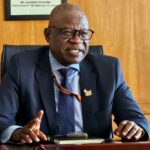



Vice President of the Republic of Zambia, Dr. W.K. Mutale-Nalumango, delivered a powerful address at the ongoing Annual Risk Management Conference in Livingstone, urging stakeholders to shift from reactive approaches to proactive strategies in dealing with risks.
Speaking before delegates, Dr. Mutale-Nalumango emphasized the need for foresight and preparedness in the face of growing global uncertainties. She stressed that waiting for risks to materialize before responding only heightens vulnerability, while early action safeguards both lives and livelihoods.
“Let us not be passive observers in the face of uncertainty. We must not wait for risks to manifest before we act. Instead, let us cultivate a culture of foresight where risk reduction becomes a proactive discipline, not a reactive obligation,” she said.
Dr. Mutale-Nalumango highlighted the Disaster Management and Mitigation Unit (DMMU), under the Office of the Vice President, as a key institution embodying this ethos. She underscored the agency’s focus on preparedness, resilience, and rapid response mechanisms designed to confront risks before they escalate into full-scale crises.
“In a world of increasing volatility, our resilience as a nation depends on our ability to anticipate, adapt, and act decisively. Risk management must begin long before the crisis knocks. It must be embedded in our planning, our governance, and our mindset,” she added.
The Vice President’s remarks come at a time when nations across the globe are grappling with the effects of climate change, public health emergencies, and economic instability. Zambia has in recent years faced recurring floods, droughts, and disease outbreaks, making the call for strengthened risk management systems both timely and urgent.
The conference in Livingstone has brought together government officials, policymakers, private sector leaders, and civil society organizations to deliberate on innovative approaches to disaster risk reduction, resilience building, and sustainable development.
Experts at the gathering are expected to present research findings, share best practices, and recommend strategies that align with Zambia’s development agenda and global frameworks such as the Sendai Framework for Disaster Risk Reduction and the Sustainable Development Goals (SDGs).
Dr. Mutale-Nalumango concluded her address by challenging institutions and communities alike to integrate risk management into their everyday operations, stressing that preparedness is not only a government duty but a shared national responsibility.
Her speech set the tone for discussions at the conference, reinforcing the importance of a forward-looking approach to safeguard Zambia’s social and economic stability in an era defined by uncertainty.